TaskQ places every AI request onto compliant capacity, uses the customer's own credentials, signs every decision, and returns proof you can verify later.
The Gateway owns auth, balance, policy, placement, lease, proof, usage, settlement, and customer-facing response headers. The execution plane can change. The proof sequence cannot.
Customer bearer + entitlement checked before work exists.
Defaults + request constraints merge without loosening hard limits.
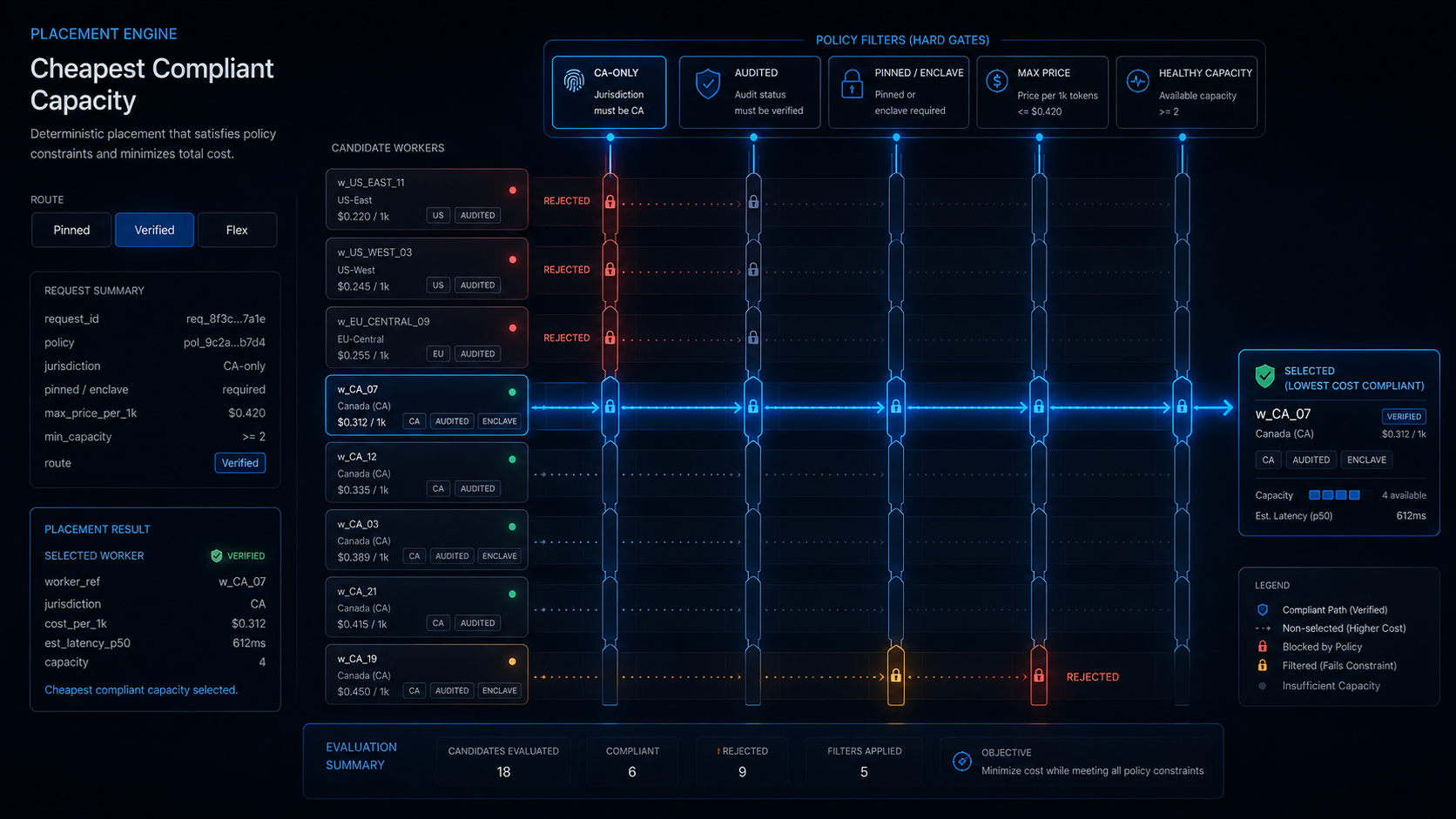
Cheapest compliant capacity. Non-compliant workers never compete.
HashIQ entry begins: request hash, policy hash, registry snapshot, lease.
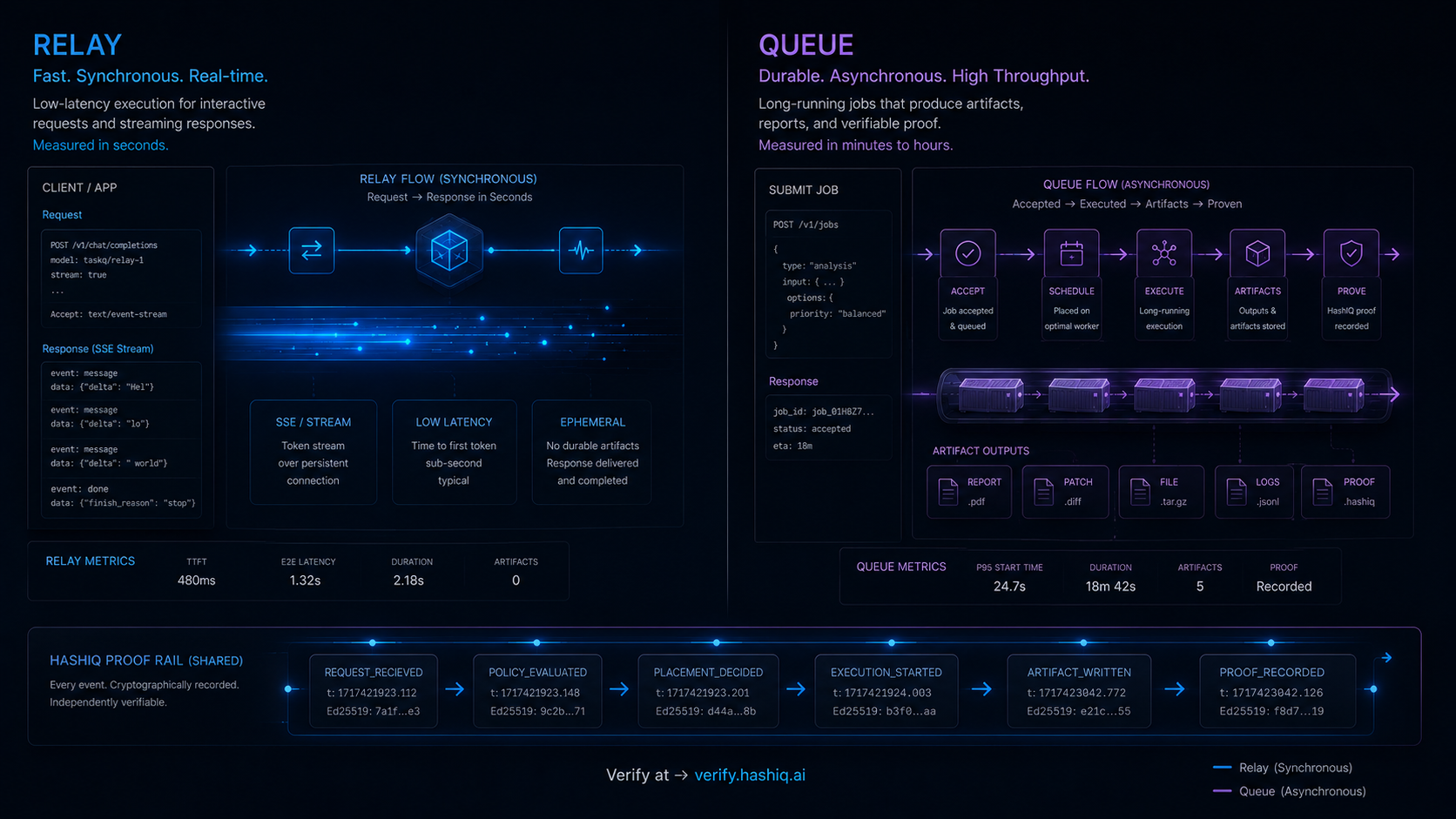
Relay handles sync API shape. Queue handles jobs and artifacts.
Usage, hashes, and terminal status seal the chain entry.
Every dollar movement journals back to a chain sequence.
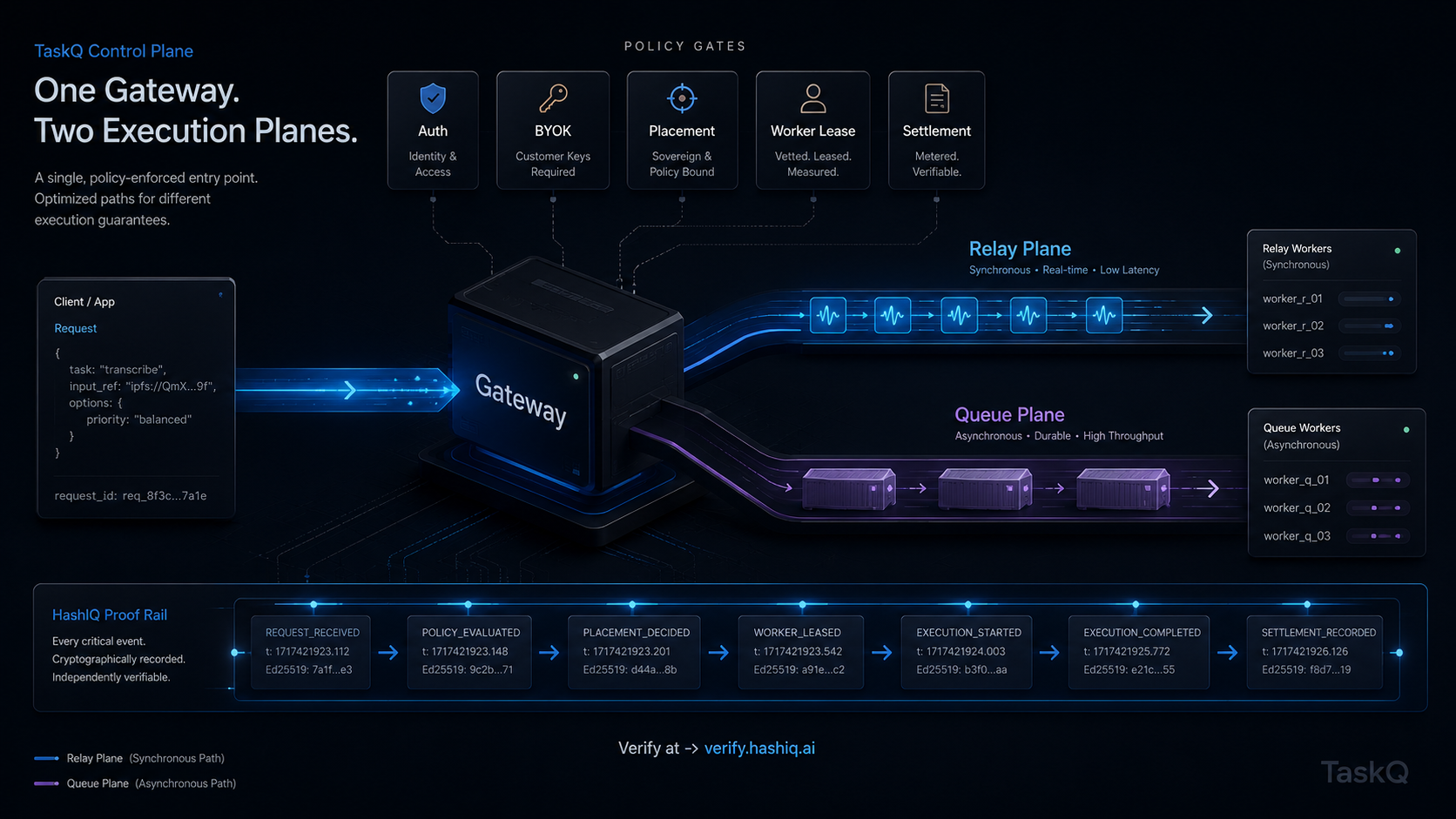
The API response is visible. The proof trail is the product. The worker network is the supply moat.

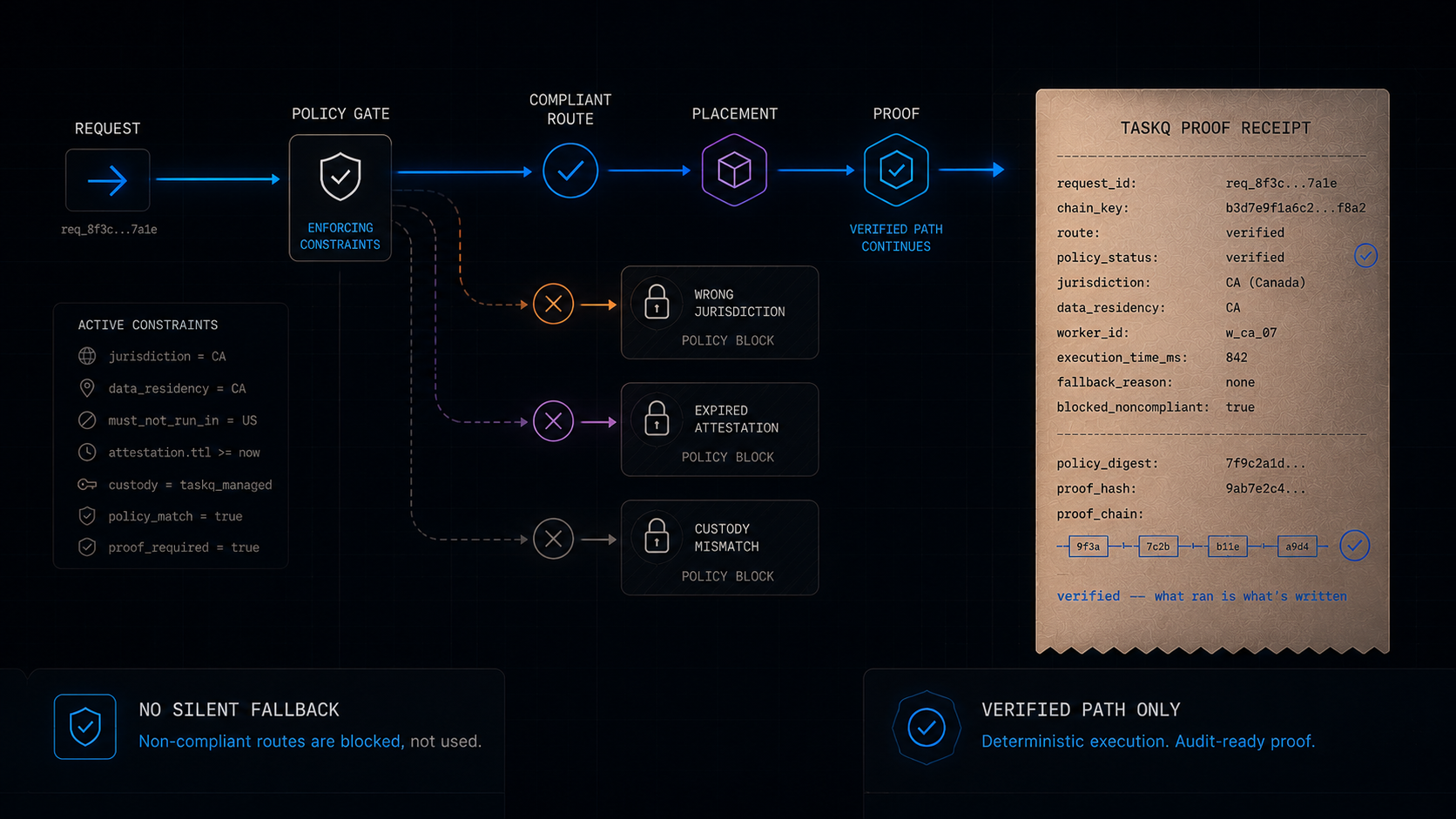
Hard constraints never relax. If no worker qualifies, TaskQ refuses with proof.
Try the solver below →
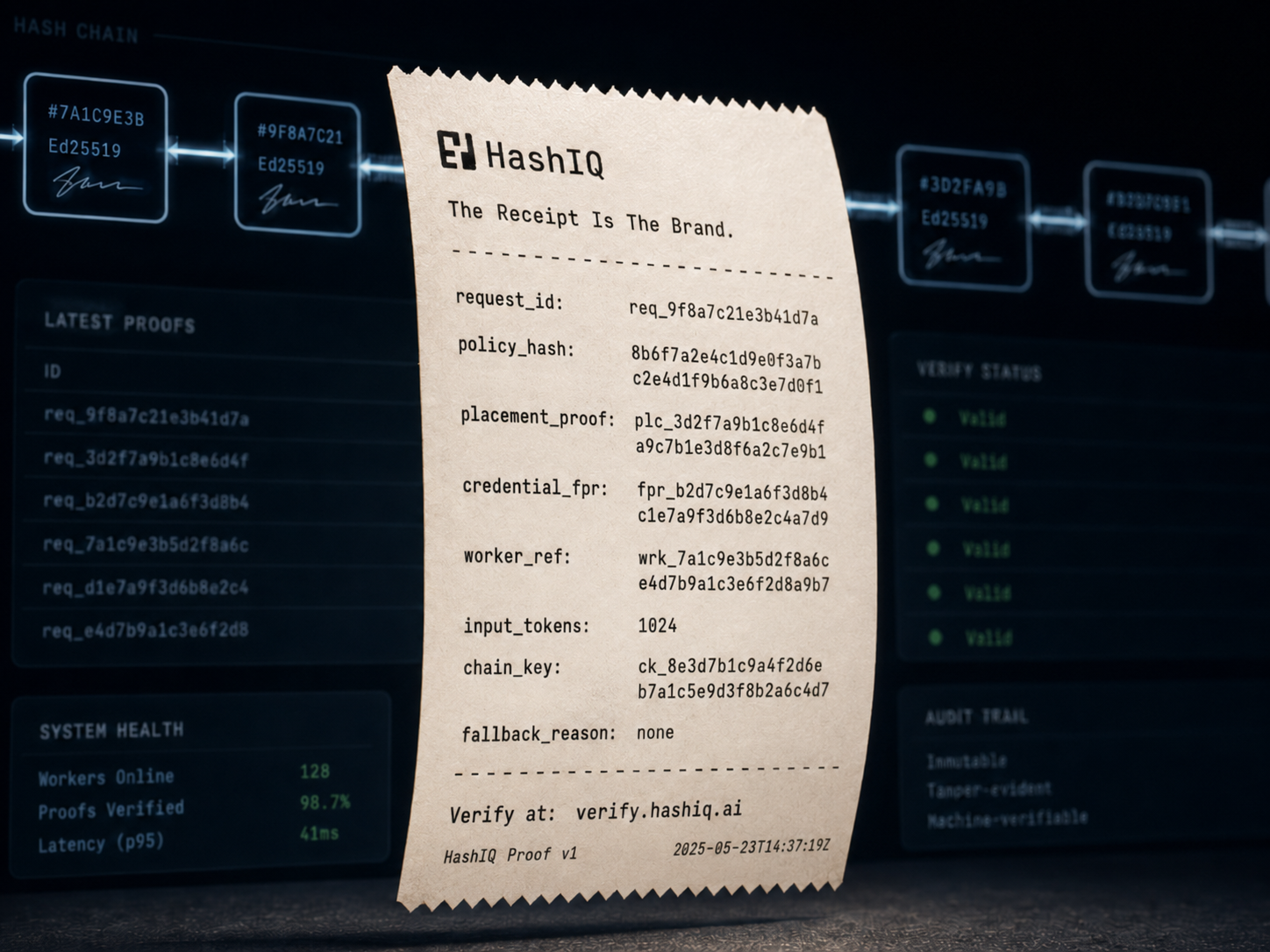
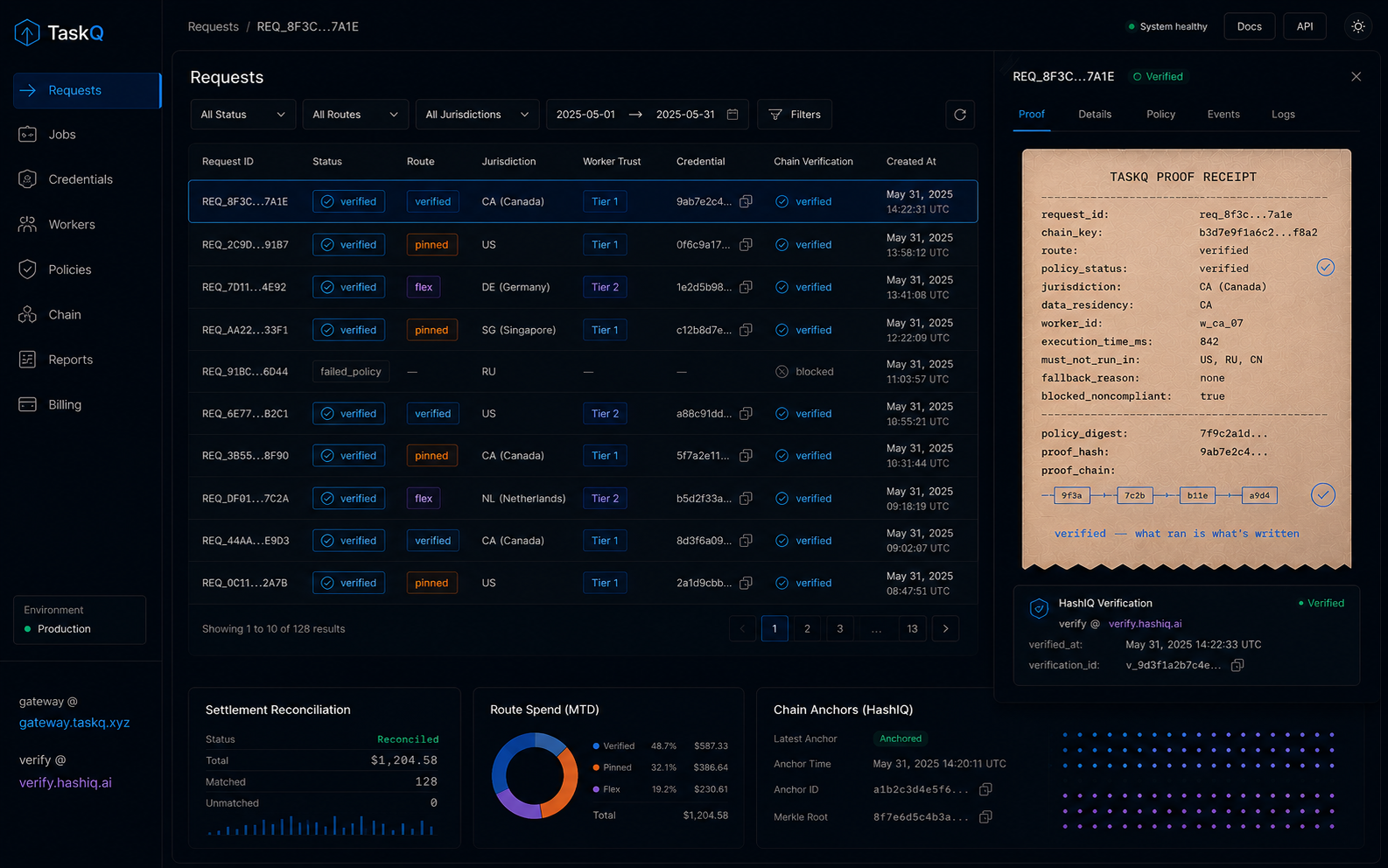
Every request becomes signed evidence: route, worker, credential, usage, settlement.
Inspect the chain →
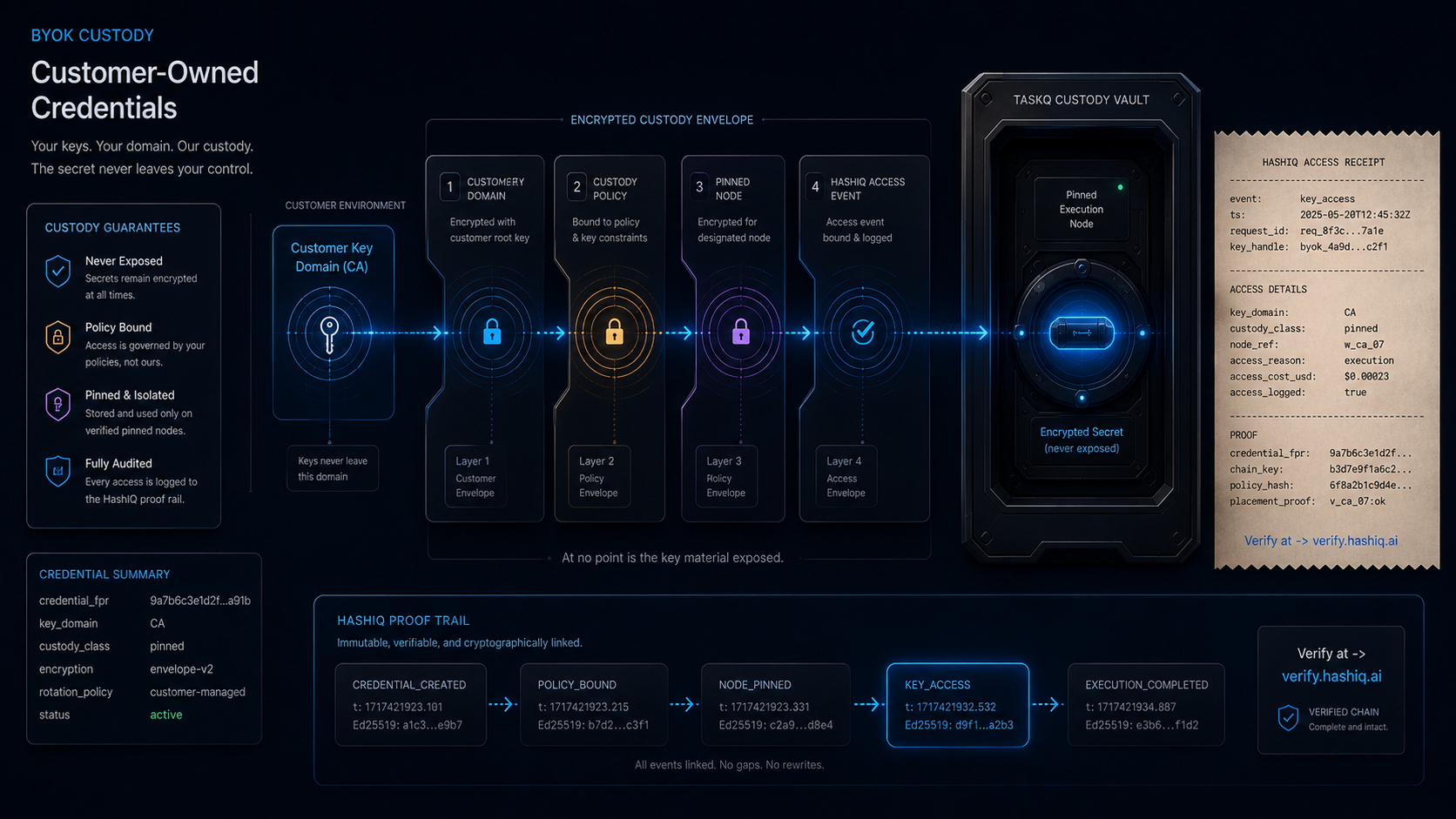
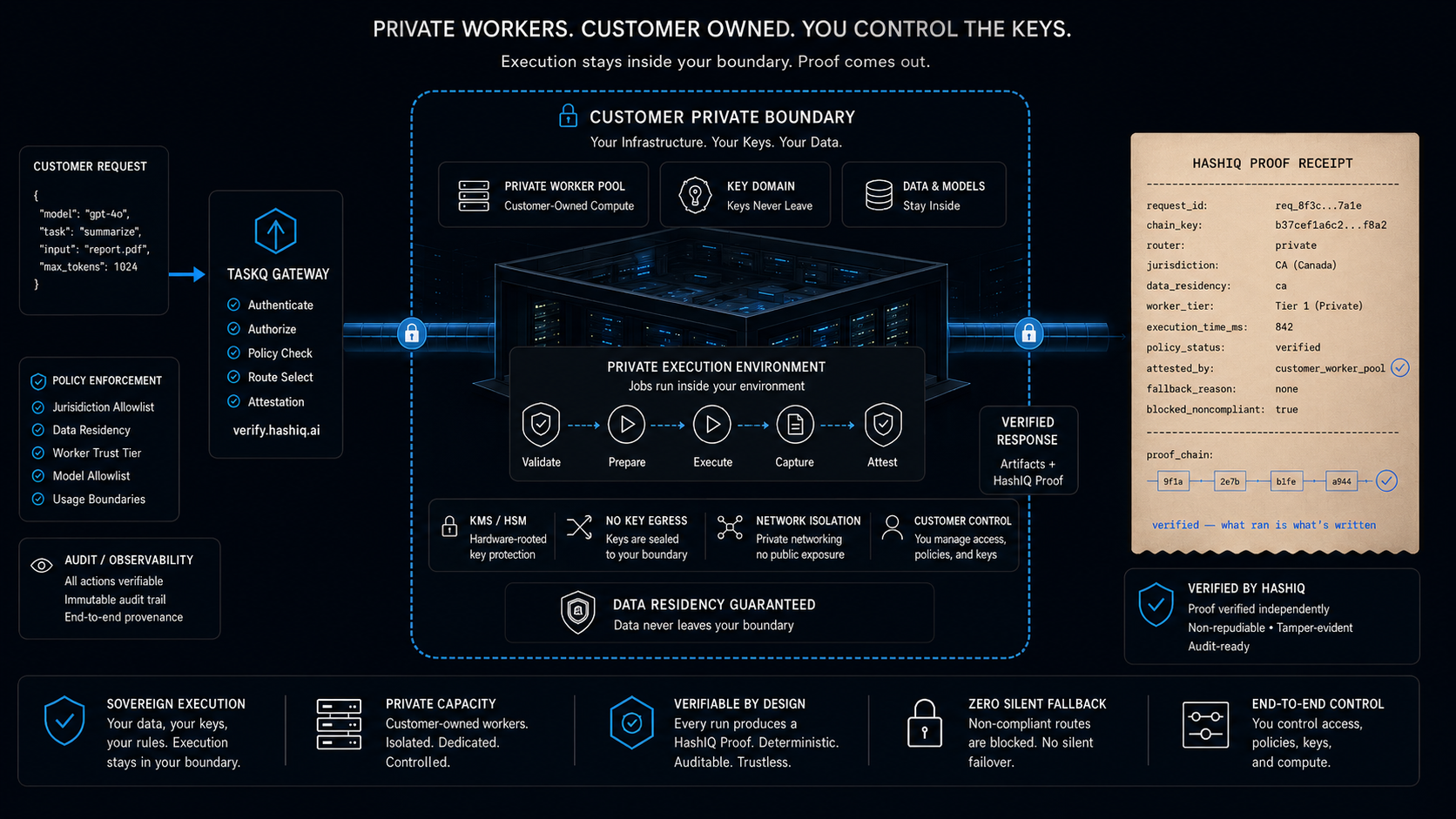
Provider spend stays customer-owned. TaskQ proves when and where keys were used.
Custody model →
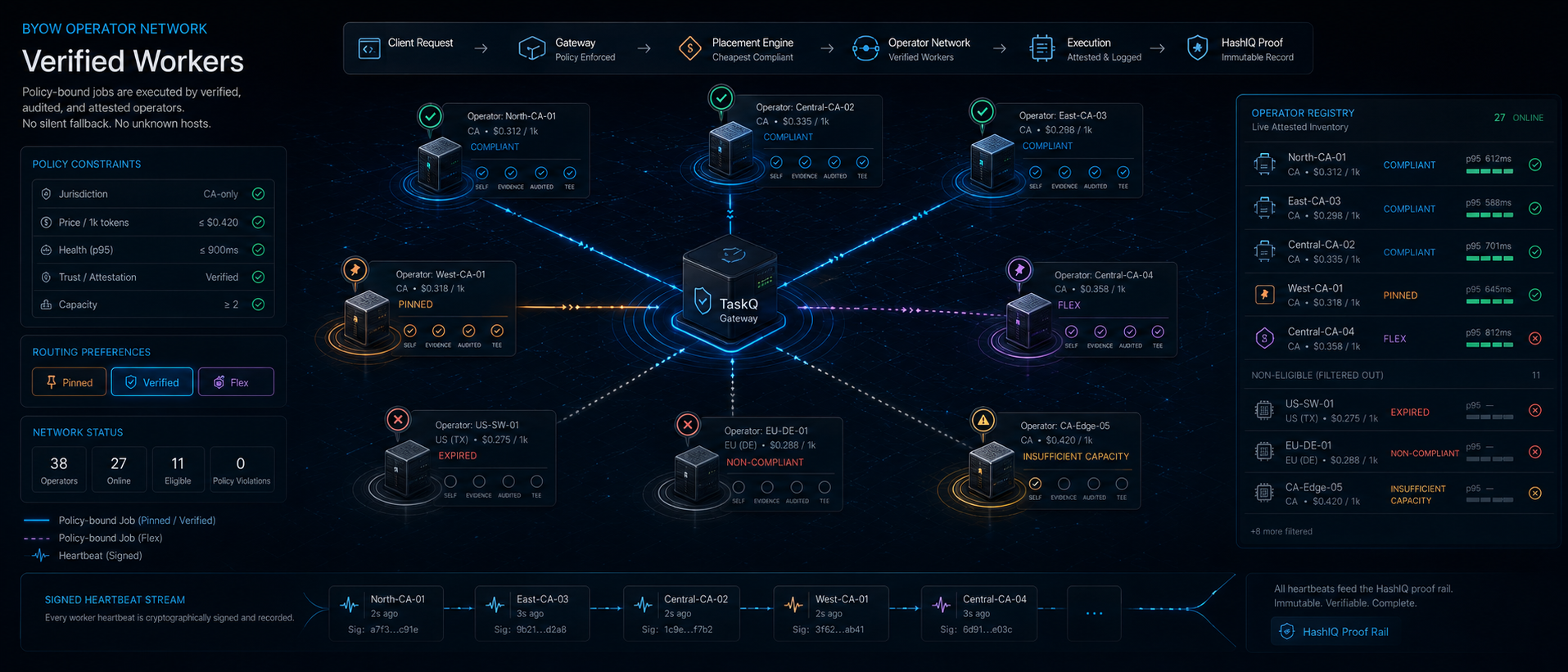
Operators contribute capacity under jurisdiction, custody, health, price, and attestations.
Operator network →Relay handles synchronous API-shaped work — chat, completions, streaming SSE. Queue handles long-running agentic jobs, reports, patches, files, and artifacts. Both share policy, placement, billing, and HashIQ proof. A chat completion routed through a queue feels broken. A multi-minute build routed through a sync proxy cannot produce deliverables.
One gateway, two planes →
Set the policy. Watch the solver exclude every worker that would make the request cheaper, faster, or easier — if it violates policy, it is not a candidate. Empty the pool and TaskQ refuses with proof.
TaskQ answers the questions normal AI platforms avoid: where did this run, which worker handled it, which credential was used, was a cheaper compliant option skipped, and can an auditor replay it?
Only fingerprints, handles, and HMAC-peppered references. Provider keys, OAuth tokens, PHI, and privileged matter names are excluded by default.
Chain heads are published to witnesses so TaskQ cannot silently rewrite yesterday's proof without detection.
Customers can leave with their signed evidence. A competitor cannot retroactively witness history they were not present to sign.
Your AI work executed under your policy, using your credential, on compliant capacity, with proof.
No silent fallback to non-compliant workers. A cheaper US worker cannot silently win a Canada-only request.
Auditors can reconstruct why the worker won from the policy hash, registry snapshot, and deterministic tie-breakers.
Customers can leave with their signed evidence. Chain heads are externally anchored so history cannot quietly move.
Settlement reconciles to request history. Closed billable chain entries require settlement journals.
TaskQ is for regulated buyers, infrastructure operators, and serious AI builders who need execution, custody, placement, and evidence in one gateway.