Control surfaces
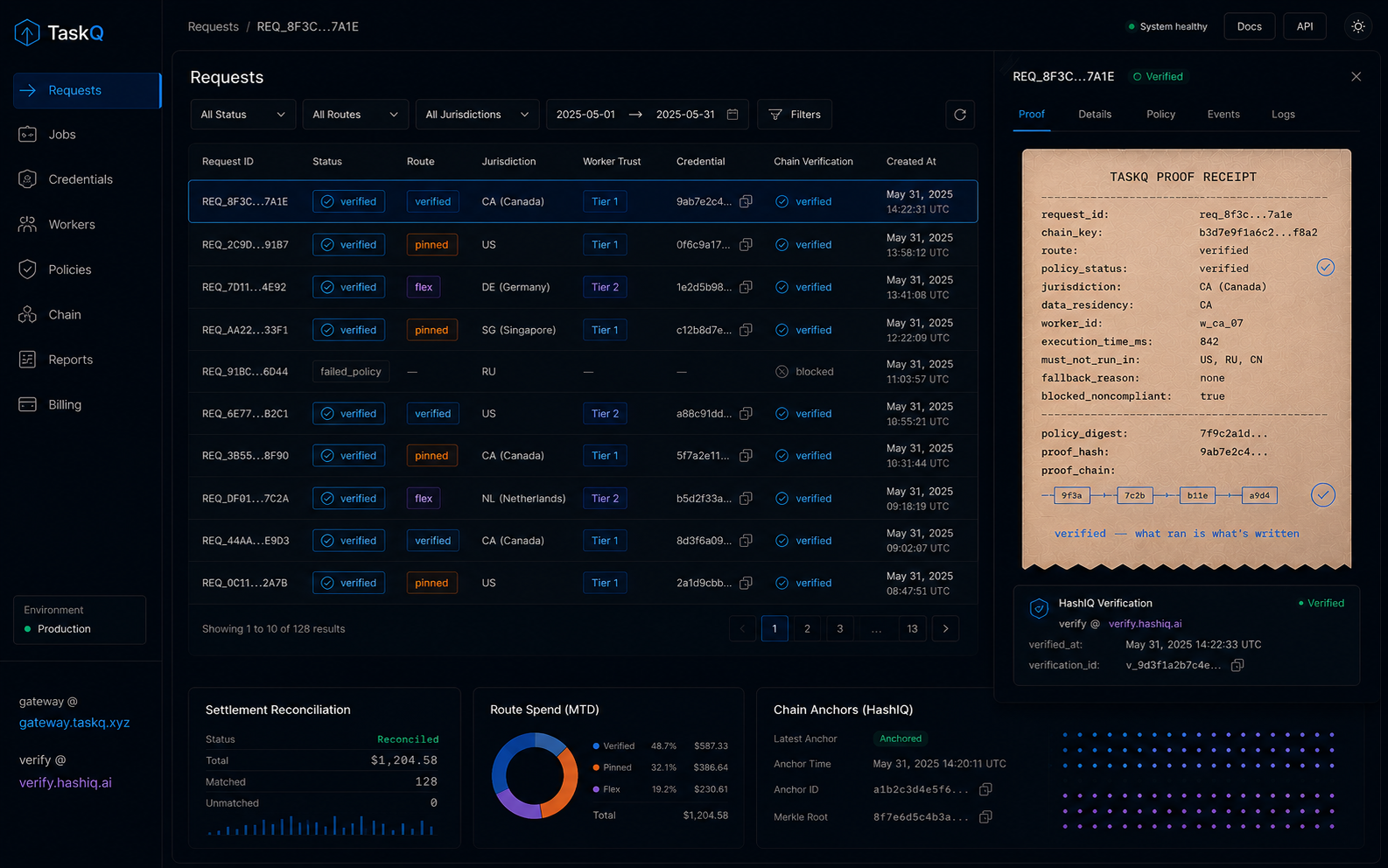
The dashboard surfaces what actually matters.
Every panel maps to a system invariant: authenticated requests, explicit custody, verified capacity, replayable placement, signed chain, and reconciled money movement.
01 · REQUESTS
Request table
Inspect request IDs, route class, plane, policy hash, credential fingerprint, worker reference, status, and proof headers.
02 · CREDENTIALS
Access history
See every credential unwrap event by request, worker, custody class, key domain, and timestamp.
03 · WORKERS
Registry state
Monitor worker health, jurisdiction, trust tier, attestation expiry, price, available slots, and lease failures.
04 · POLICIES
Hard constraints
Manage default policies, request-level tightening, cost ceilings, custody floors, approved regions, and blocked routes.
05 · CHAIN
Proof viewer
Open HashIQ entries, verify signatures, check anchors, replay placement, and export signed evidence.
06 · BILLING
Settlement parity
Confirm every billable chain entry maps to one journal entry, one customer debit, and one operator credit.